
Best Addiction Treatment Center in Islamabad — Umeed-e-Shifa
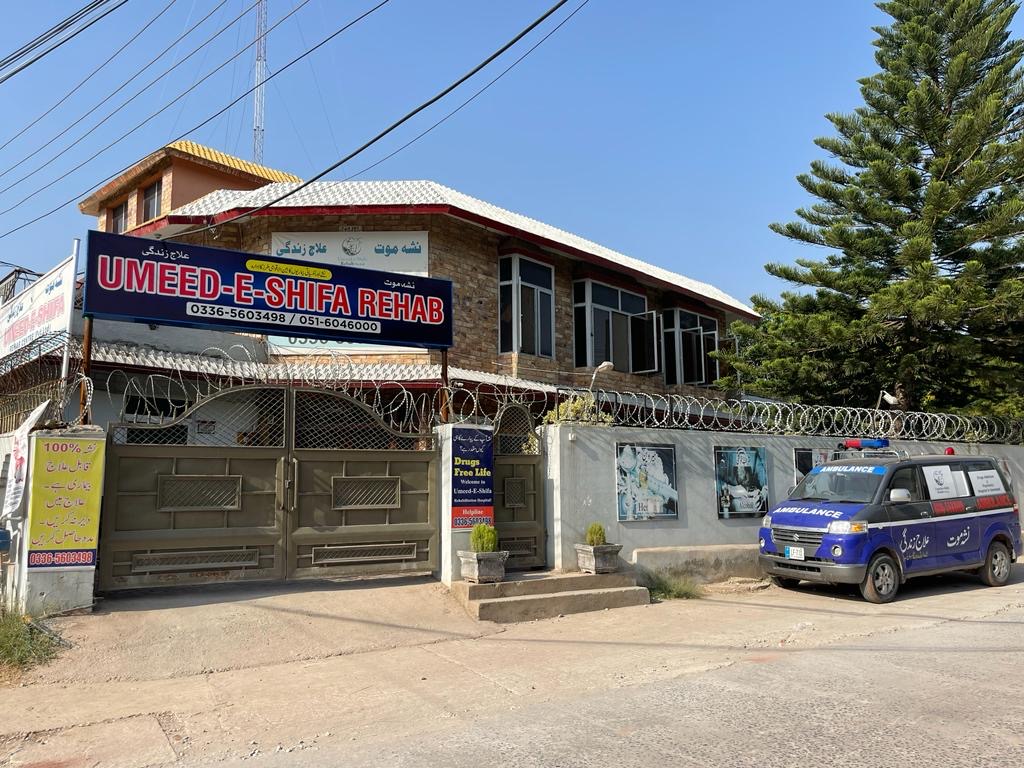
You’re probably not the one who needs treatment. You’re the one holding the phone, wondering whether this center is legitimate, whether your loved one will be safe, and whether Rs. 3,500 consultation fee on Oladoc is the whole story or just the beginning. You’ve already read three or four rehab center websites that all say the same thing: compassionate care, qualified staff, proven results. None of them told you what actually happens on the first night. Or what therapy methods they use. Or what to do if the patient refuses to go. This page covers all of that — specifically for Umeed-e-Shifa Rehabilitation Center in Bani Gala, Islamabad. No promotional language. Just the information that helps you make a sound decision. Why Bani Gala, and Why It Matters More Than Families Realize Every rehab center in Islamabad claims a “peaceful environment.” Bani Gala actually delivers one — and the difference is clinical, not cosmetic. Addiction treatment works partly because it removes a person from the physical cues that trigger craving. In neuroscience, these are called environmental cues — the streets, the contacts, the routines that the brain has wired to drug-seeking behavior. Patients in dense urban neighborhoods remain surrounded by those cues even while undergoing treatment. That’s a structural disadvantage. Bani Gala sits on a hillside southwest of the city, 20–25 minutes from Islamabad’s central sectors, surrounded by trees and largely cut off from the supply networks that operate in areas like G-10, Aabpara, or Rawalpindi’s inner city. The environment isn’t a luxury perk — it’s part of why the first weeks of treatment in Bani Gala produce better engagement from patients. Umeed-e-Shifa is located at House No. 1, Durrani Street, Main Jinnah Road, Bani Gala, Islamabad. It operates 24 hours a day, seven days a week. It is registered with both SECP (Securities and Exchange Commission of Pakistan) and the Islamabad Health Regulatory Authority (IHRA) — the two credentials that tell you a facility is operating legally and within medical oversight, not as an unregulated holding space. What Umeed-e-Shifa Actually Is — And Who It’s For Umeed-e-Shifa is an inpatient and outpatient psychiatric rehabilitation facility. It was established in 2020. It treats substance use disorders and co-occurring psychological conditions — which is a critical distinction we’ll come back to. The center is suitable for: It is not a drop-in detox clinic. It’s not appropriate for someone who needs only outpatient support. And it cannot guarantee outcomes — no facility can, and any center that implies otherwise is misleading you. The Therapy Methods — The Detail Every Competitor Skips This is where Umeed-e-Shifa separates itself on paper from most centers in Islamabad. Not all rehab centers disclose their clinical methodology. Umeed-e-Shifa’s website explicitly names the following: CBT (Cognitive Behavioral Therapy) — The most extensively researched method in addiction treatment. It works by identifying thought patterns that lead to substance use and replacing them with structured responses. CBT is first-line treatment for cannabis, alcohol, and stimulant addiction. DBT (Dialectical Behavior Therapy) — Originally developed for borderline personality disorder, DBT is now widely used for people whose addiction is driven by emotional dysregulation — inability to tolerate distress without using. It’s particularly relevant for patients who relapse when stressed or emotionally overwhelmed. MET (Motivational Enhancement Therapy) — Used specifically for patients who aren’t convinced they have a problem or aren’t ready to engage in full treatment. MET doesn’t push. It builds internal motivation over structured sessions. This matters enormously for patients who were admitted under family pressure rather than their own choice. CM (Contingency Management) — A behavioral reinforcement method with strong research backing, particularly for stimulant and opioid addiction. It uses structured rewards to reinforce abstinence behaviors. REBT (Rational Emotive Behavior Therapy) — Targets irrational belief systems that sustain addictive behavior. Useful for patients whose addiction is partly maintained by distorted thinking about themselves or the world. Hypnotherapy — Used as a supplementary method, not a standalone treatment. Helps with anxiety management and accessing unconscious patterns contributing to substance use. The 12-step recovery model is also incorporated as a framework for group sessions. Why does this list matter? Because when you’re evaluating a rehab center, the specific methods used determine whether a patient receives actual clinical treatment or just supervision and rest. A center with only counselors and no formal clinical protocols is not offering therapy — it’s offering monitoring. The Two Programs: Who Should Choose Which Most families make this choice based on cost or time available. That’s the wrong basis. Here’s the clinical reasoning. 30-Day Program — Who It’s Actually For The 30-day detox program is appropriate for: It is not adequate for someone who has been using for more than a year, has relapsed after previous treatment, or has a diagnosed or suspected psychiatric condition. Families who choose 30 days for cost reasons in these cases are, statistically, paying for a second full admission within a few months. 90-Day Program — When This Is the Right Call The 90-day detox and assessment program with effect management is designed for: The structure is three phases: physical detox and medical stabilization in weeks one and two, psychiatric assessment and behavioral therapy introduction in weeks three through six, and relapse prevention, family sessions, and discharge planning in weeks seven through thirteen. Each phase builds on the one before it. Cutting the process short at 30 days means leaving before the behavioral therapy phase has done enough work. A 2025 systematic review of Pakistani rehabilitation cases, published in clinical health literature, found that patients completing longer structured programs showed significantly better 12-month sobriety outcomes than those completing detox-only stays. What Happens in the First 72 Hours — What Nobody Tells You This is the question families are most afraid to ask, and most centers simply don’t answer it. When a patient arrives at Umeed-e-Shifa, the first step is a clinical assessment — psychiatrist-led, covering substance use history, psychiatric history, medical history, and current physical condition. Based on that, a medical detox