
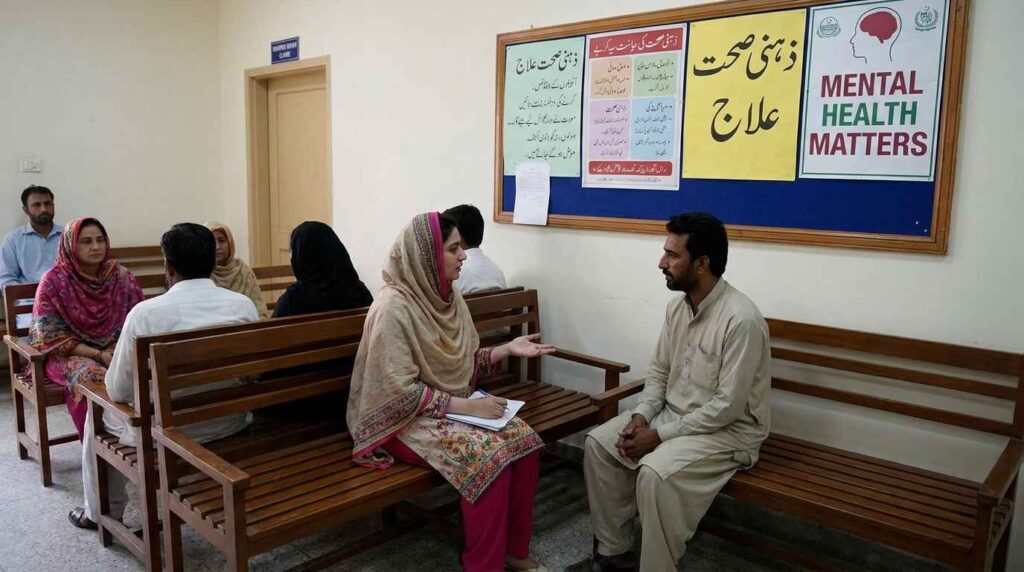
Why mental health treatment in Pakistan looks different than what families expect
Most families searching for mental health treatment in Pakistan are not researchers. They’re a mother who hasn’t slept in three nights, a brother watching addiction take over, or a young professional who finally admitted something is wrong. The system they’re about to enter is fragmented — and nobody hands them a map.
Pakistan has an estimated 24 million people living with a mental health condition (Pakistan Association for Mental Health, 2023 estimate). Yet the country has fewer than 500 trained psychiatrists across both public and private sectors. That mismatch shapes everything: wait times, quality, cost, and what “treatment” actually means once you walk through the door.
This guide is written for families in Islamabad, Rawalpindi, and across Pakistan who need clear answers — not brochures.
What does mental health treatment in Pakistan actually include?
Mental health treatment in Pakistan is the structured care of psychiatric, psychological, and behavioral conditions through a combination of medication, talk therapy, rehabilitation, and family support. Real treatment is rarely just a prescription.
A credible program includes:
- Psychiatric assessment by a qualified psychiatrist (MBBS + FCPS Psychiatry or equivalent)
- Medication management with regular review, not one-time prescribing
- Psychotherapy — typically CBT, DBT, or supportive therapy delivered by a clinical psychologist
- Family therapy in the patient’s first language (Urdu, Punjabi, Pashto)
- Occupational and recreational therapy during inpatient stays
- Aftercare and relapse-prevention planning for the first 6 months post-discharge
If a center skips three or more of these, you’re looking at a holding facility, not a treatment program.
Public vs. private mental health care in Pakistan: the honest comparison
The decision most families face isn’t which hospital — it’s which type of system. The trade-offs are real.
| Factor | Public Hospitals (PIMH, IoP Rawalpindi) | Licensed Private Centers (Islamabad) |
|---|---|---|
| Cost | Free or nominal (PKR 50–500 OPD) | PKR 150,000–600,000/month inpatient |
| Wait time for admission | Days to weeks | Usually same-day to 48 hours |
| Bed availability | Often over-capacity | Limited but managed |
| Family involvement | Minimal | Structured family sessions |
| Privacy | Shared wards | Private or semi-private rooms |
| Aftercare | Variable | Written plan standard |
| Best for | Acute stabilization, low-income families | Mid-to-long-term recovery, dignity, dual diagnosis |
Public hospitals save lives every day. They also work at scale that no private center can match. But for a family that wants therapy in addition to medication, structured family work, and a real discharge plan, a licensed private rehab is usually the better fit — if the budget allows.
How much does mental health treatment cost in Pakistan?
Costs vary widely. Here’s what families in Islamabad and Rawalpindi typically pay in 2026:
| Service | Typical Cost Range (PKR) |
|---|---|
| Psychiatrist consultation (private) | 3,000 – 8,000 per session |
| Clinical psychologist session | 2,500 – 6,000 per session |
| Inpatient psychiatric care (private, monthly) | 150,000 – 600,000 |
| Inpatient rehab (addiction + psychiatric, monthly) | 200,000 – 700,000 |
| Public hospital OPD | 50 – 500 |
| Public hospital inpatient | Free to nominal |
Pricing changes. Verify current rates on the official website of any center before committing.
The Sehat Sahulat Program now covers some psychiatric admissions in empaneled hospitals — a meaningful 2024–2025 expansion — but most private rehab remains self-pay.
Choosing a rehabilitation center in Islamabad: what to actually check
Bani Gala and surrounding areas of Islamabad have become a hub for licensed private rehabilitation, partly because of the quieter setting and proximity to specialists. If you’re evaluating a center, ask these questions before you sign anything:
- Is the center licensed by the Islamabad Healthcare Regulatory Authority (IHRA)? Ask for the registration number.
- Who is the on-site psychiatrist and what are their credentials? A visiting consultant once a week is not the same as a resident psychiatrist.
- What is the patient-to-staff ratio at night? This is when most incidents happen.
- Is dual diagnosis handled? Addiction with depression, bipolar, or psychosis needs combined treatment, not sequential.
- What does aftercare include? A real program covers the first 90 days post-discharge minimum.
- Is family therapy in Urdu available? English-only therapy fails most Pakistani families.
- Can you visit before admission? Centers that refuse pre-admission visits are hiding something.
A short note worth bookmarking: walk the facility yourself. Photos lie. Smell, lighting, staff body language, and how patients are spoken to in the hallway tell you more than any brochure.
When forced admission is legal in Pakistan — and when it isn’t
Involuntary admission is allowed under provincial mental health legislation (Sindh Mental Health Act 2013, Punjab Mental Health Act 2014, and ICT-applicable ordinance) when a person poses a clear risk to themselves or others, or cannot make treatment decisions due to severe illness. Two qualified psychiatrists must typically certify the admission, and the patient has the right to review.
This matters. Families sometimes admit a loved one in panic without the legal paperwork, then face complications later. A reputable center will walk you through this process formally — not informally.
Pros and cons of inpatient rehabilitation in Pakistan
Pros:
- Removes the patient from triggers (relationships, substances, work stress)
- 24/7 medical supervision during medication adjustment
- Structured therapy schedule that’s hard to maintain at home
- Peer support from others in recovery
Cons:
- Cost is a real barrier for most families
- Stigma — neighbors and extended family ask questions
- Re-entry shock when the patient returns home without a plan
- Quality varies sharply between licensed and unlicensed centers
The honest read: inpatient works best for moderate-to-severe cases, addiction with relapse history, or when the home environment itself is part of the illness. For mild-to-moderate depression and anxiety, outpatient therapy plus medication is usually equally effective and far cheaper.
Aftercare: the part most Pakistani centers skip
Six months after discharge is when relapse risk is highest. A solid aftercare program includes weekly outpatient sessions for the first month, a step-down to fortnightly, family check-ins, medication reviews every 4–6 weeks, and a written crisis plan with phone numbers.
If the center you’re considering can’t show you a sample aftercare plan in writing, treat that as a serious red flag. This is the single biggest gap in Pakistani mental healthcare — and the one differentiator that separates a recovery program from a holding facility.
Stigma, privacy, and protecting the family
Pakistani families carry a real social cost when seeking psychiatric care. Confidentiality should be contractual, not a verbal promise. Ask the center directly: who has access to records, what is shared with referring doctors, and what their data policy is. Licensed centers in Islamabad operate under PHC and IHRA confidentiality standards — but enforcement depends on the center’s own culture.
A practical tip families rarely think about: admit under the patient’s CNIC name only, not extended family identifiers, and keep visitor logs limited to immediate family.
Final word
Mental health treatment in Pakistan in 2026 is more accessible than it was five years ago — but the gap between a good center and a bad one is wider than ever. The families who get the best outcomes are the ones who ask hard questions, visit before admitting, and choose a program that treats the person, not just the symptoms. If someone you love is struggling, the next step isn’t to read another article. Walk into a licensed center this week, sit with the clinical team, and trust what you see with your own eyes.
FAQ Section
1. Is mental health treatment free in Pakistan? Public hospitals like PIMH Lahore and the Institute of Psychiatry Rawalpindi offer free or nominal-cost treatment, including OPD, inpatient care, and basic medication. Private centers and licensed rehabilitation facilities are self-pay, with monthly inpatient costs typically between PKR 150,000 and 600,000. The Sehat Sahulat Program covers some psychiatric admissions at empaneled hospitals.
2. What is the best mental health hospital in Pakistan? There isn’t a single best — it depends on need. PIMH Lahore handles the highest volume of acute psychiatric cases. The Institute of Psychiatry Rawalpindi serves Islamabad and northern Punjab. For private rehabilitation with structured therapy, licensed centers in Islamabad’s Bani Gala area, including Umeed e Shifa, are commonly recommended for mid-to-long-term recovery.
3. How much does a psychiatrist cost in Islamabad? A private psychiatrist consultation in Islamabad typically costs between PKR 3,000 and 8,000 per session in 2026. Senior consultants at hospitals like Shifa International or Maroof International charge at the higher end. Public hospital OPD consultations cost PKR 50–500. Always confirm fees when booking, as rates change.
4. Can you force someone into rehab in Pakistan? Involuntary admission is legal under provincial mental health laws when the person poses a risk to themselves or others, or lacks decision-making capacity due to severe illness. Two qualified psychiatrists must certify the admission. Families should never bypass this legal process — a reputable center will guide you through proper documentation.
5. Does health insurance cover mental health treatment in Pakistan? Coverage is limited but expanding. The Sehat Sahulat Program covers some psychiatric inpatient care at empaneled hospitals as of 2024–2025 updates. Private health insurance plans from companies like Jubilee, EFU, and Adamjee may cover psychiatric consultations and limited inpatient stays — read the policy exclusions carefully, as mental health is often capped or excluded.
6. What’s the difference between a psychiatrist and a psychologist in Pakistan? A psychiatrist is a medical doctor (MBBS plus FCPS Psychiatry) who can diagnose and prescribe medication. A clinical psychologist holds an MS or PhD in clinical psychology and provides talk therapy like CBT or DBT but cannot prescribe. Most serious cases need both — medication from a psychiatrist and therapy from a psychologist working together.
7. How long does inpatient psychiatric treatment take in Pakistan? Typical inpatient stays range from 2 to 12 weeks, depending on diagnosis. Acute stabilization (severe depression, psychosis, mania) usually takes 2–4 weeks. Addiction with co-occurring psychiatric illness often requires 8–12 weeks of inpatient care followed by 6 months of structured aftercare. Discharge timing should depend on clinical readiness, not calendar dates.
8. Are there good rehabilitation centers in Islamabad? Yes, Islamabad has several licensed rehabilitation centers, particularly in quieter areas like Bani Gala and the F-sector residential zones. Centers such as Umeed e Shifa, Willing Ways, and others operate under IHRA licensing. Quality varies, so verify licensing, on-site psychiatric staffing, and aftercare structure before admitting a family member.
9. How do I choose the right rehab for a family member? Visit in person before admitting. Confirm IHRA licensing, ask about the on-site psychiatrist’s credentials, request a sample aftercare plan in writing, check patient-to-staff ratios at night, and ensure family therapy is offered in your spoken language. If a center refuses a pre-admission visit, choose somewhere else.
10. Is treatment confidential in Pakistani rehab centers? Licensed centers operate under PHC and IHRA confidentiality standards, but enforcement depends on each facility’s internal culture. Get the confidentiality policy in writing, ask who can access patient records, and limit visitor and contact lists at admission. Confidentiality should be a written contract, not a verbal assurance.