Ice Addiction in Pakistan: Signs, Causes & How to Get Out (2026)
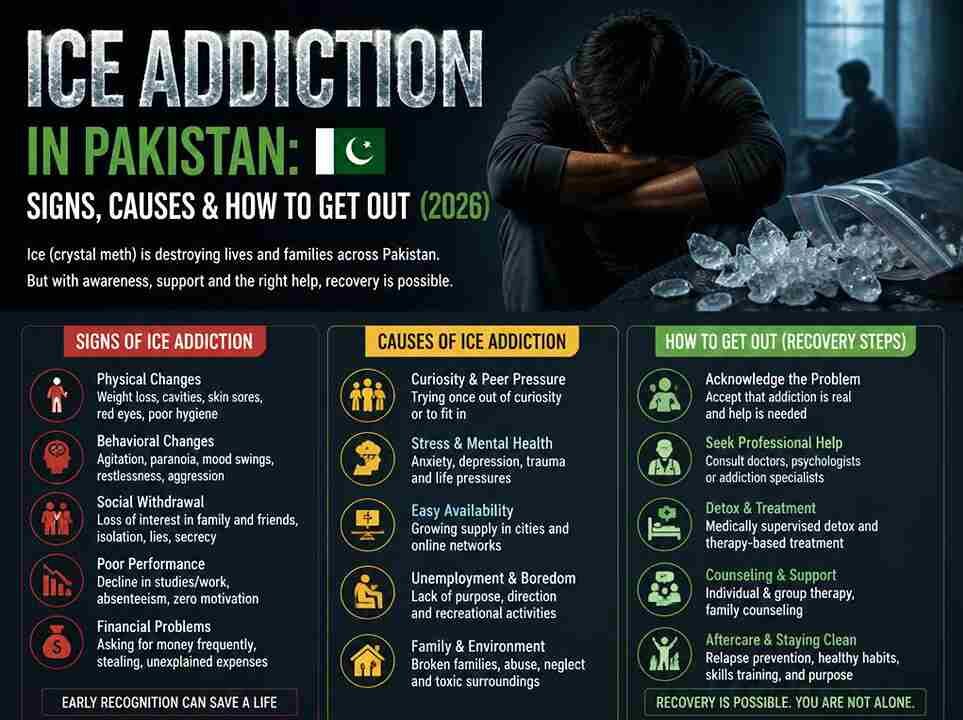
A father in Rawalpindi spent three months convinced his son had depression. The weight loss, the sleeping for two days then disappearing for three, the paranoia about neighbours, the money missing from the house. A doctor prescribed antidepressants. They didn’t help. Then a friend of the family said two words: ice nasha. That story plays out in Islamabad, Lahore, Peshawar, and Karachi every week. The details change. The delay doesn’t. Most families lose months — sometimes years — to the wrong diagnosis, the wrong approach, or the belief that things will settle on their own. They don’t settle. Ice addiction gets worse when left alone. But it does respond to the right treatment — and understanding what that treatment actually involves is the first useful step a family can take. What Ice Is, and Why It Hooks People So Fast Ice is crystal methamphetamine. In Pakistan it’s known as آئس, shesha, crystal, or simply nasha. It looks like fragments of clear or bluish glass — hence the name — and is most commonly smoked through a pipe, though it can be snorted or injected. What makes it different from most other drugs is the speed and intensity of dependence. Cannabis or alcohol typically take months or years of regular use before dependency sets in. With ice, some people report losing control of their use within a few weeks. That’s not an exaggeration — it’s a neurological reality. Here’s what’s happening: the brain has a dopamine system that regulates pleasure, motivation, and reward. Normal experiences — a good meal, exercise, connection with people — trigger a modest dopamine response. Ice triggers a flood. According to the National Institute on Drug Abuse (NIDA), methamphetamine produces dopamine release roughly three times greater than cocaine. The high is brief and intense. The crash that follows is brutal. With repeated use, the brain responds by scaling back its own natural dopamine production. The person becomes chemically unable to feel normal without the drug. Food tastes like cardboard. Ordinary life feels grey and pointless. Only ice makes things feel real again. That’s not weakness. That’s what the drug does to the brain’s reward circuitry. And it’s why the standard advice — “just stop, be strong, make a decision” — fails almost every time. Why Ice Use Has Exploded in Pakistan Since 2022 This isn’t a long-running crisis. It accelerated sharply and recently, and the reason matters for understanding who’s at risk. After the Taliban banned poppy cultivation in Afghanistan in 2022, drug traffickers who previously moved heroin shifted toward synthetic alternatives. Crystal methamphetamine doesn’t require a growing season. It can be produced year-round in a lab, in small quantities, and transported in ways that are harder to intercept. Punjab Police seized 404 kg of ice in just the first five months of 2026, compared to 175 kg for all of 2024 and 61.9 kg in 2023 — a 131% year-over-year increase. That surge in supply drove price down. Ice that was once expensive and confined to specific social circles is now reaching university hostels, working-class neighbourhoods, and small cities outside the major urban centres. The Anti-Narcotics Force (ANF) reported seizing 5.467 metric tons of methamphetamine in 2024 alone. The people most affected are overwhelmingly young. The most vulnerable segment of society is youth ranging in ages from 18 to 35 years — from doctors to engineers, sportsmen to entrepreneurs. The drug entered through performance culture first: students in high-pressure academic programmes discovered it kept them awake for 48-hour study sessions. The framing was “I’m not using drugs, I’m working.” By the time the studying stopped making sense and the grades collapsed, the dependency was already dug in. Three People Who End Up Addicted to Ice — and Why They’re Different Most articles on ice addiction describe a generic “user.” That framing misses something important: the path into ice addiction shapes what treatment needs to address. There are three distinct profiles that appear consistently. The performance seeker. A medical student, engineering candidate, or competitive exam taker who starts using ice to study longer. The drug delivers — initially. Nights that used to end at 2 AM now stretch to 6 AM with the material still going in. Then the dose needs to increase to get the same effect. Then use starts happening outside exam periods. By the time this person seeks help, there’s often a genuine psychiatric presentation alongside the addiction — anxiety disorder, paranoia — that emerged partly from the drug and partly from an academic environment that had been running on fumes and stimulants. The social initiation. A young professional or university student who encounters ice at a gathering where it’s offered alongside alcohol. Early use feels recreational and controlled. “I only use it on weekends” holds for a while. Then the weekends start on Thursdays. This profile often comes with significant shame — because the person had no intention of “becoming an addict” and can’t reconcile that identity with who they thought they were. The person self-medicating. This one is missed most often, including by families and sometimes by clinicians. Pakistan has an enormous unmet mental health burden. Depression, untreated trauma, anxiety disorders, and undiagnosed bipolar disorder are widespread but carry severe stigma. Many people who develop ice dependency were already living with psychological pain that nobody had given a name or treatment. Ice provided relief — not euphoria exactly, but a temporary lifting of the weight. Treatment for this person that doesn’t address the underlying condition will fail. They’ll get clean and feel the original pain come rushing back without any tools to manage it, and the pull back toward the drug becomes almost irresistible. Knowing which profile applies changes what treatment needs to look like. A good rehabilitation assessment figures this out before the treatment plan is built. What Ice Does to the Body — the Parts Families Don’t Expect The visible physical effects of ice addiction are well known. Rapid weight loss. Dental decay. Skin sores. These are real. What